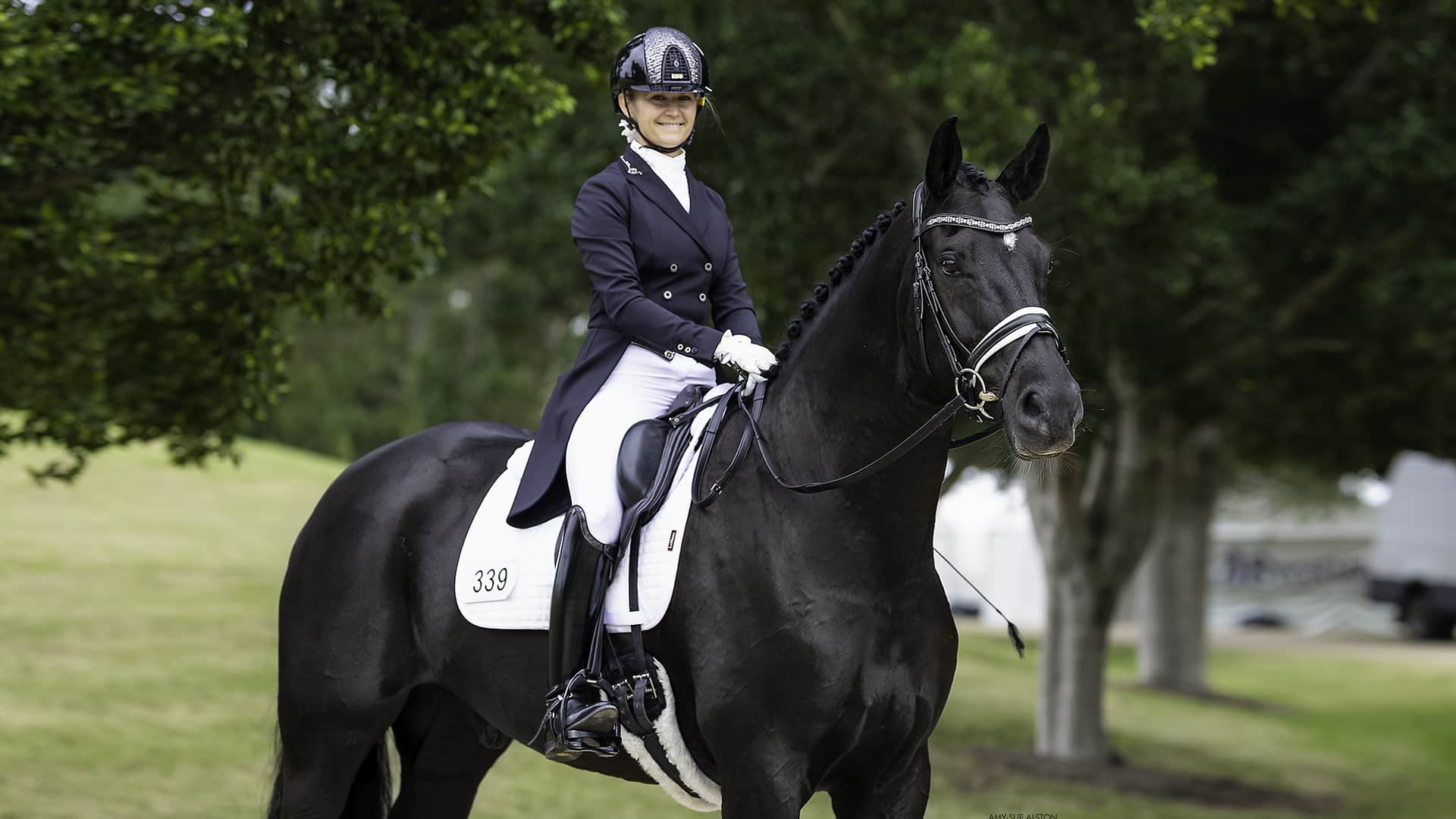
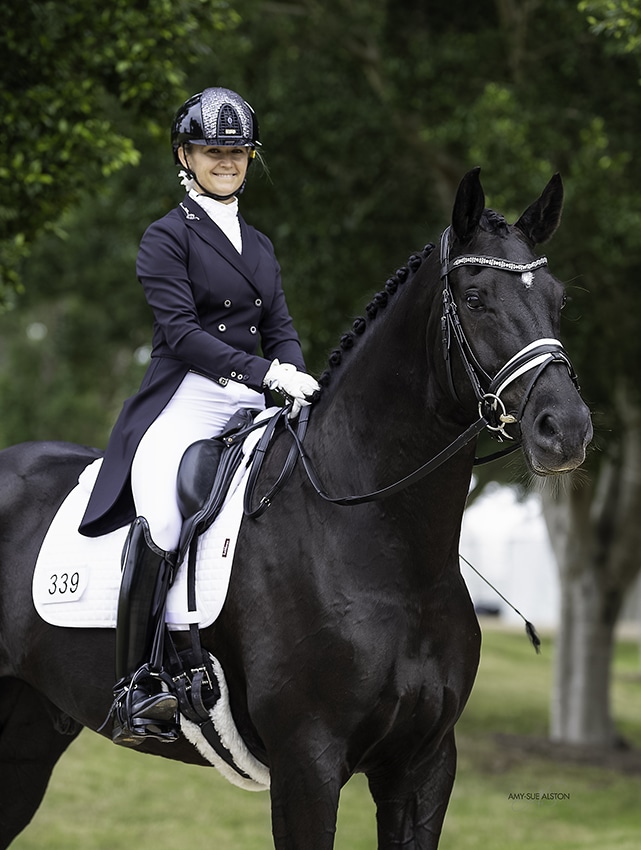
Emma Flavelle-Watts and Scarlatti Mio VSR. Image by Amy Sue Alston.


For most riders, the path to a Grand Prix horse is paved with years of careful scouting, strategic planning, and deliberate decisions. But for Australian dressage rider Emma Flavelle-Watts, her partnership with the gorgeous dark gelding Scarlatti Mio VSR (San Amour x World Diamond O) began almost by accident – one persistent phone call at a time.
“I wasn’t looking for a horse,” Emma laughs now, remembering how firmly she’d said no at the time. “But Kaitlin Colless [from Sevenoaks Farm] kept at me about coming to have a look. Eventually I gave in.” What she found in a Queensland paddock was a big, handsome six-year-old with a kind eye – and a medical complication that meant she wouldn’t even get to sit on him before deciding whether he would be hers.
Scarlatti, bred by Sandra Paeschke in Tasmania and owned by Kaitlin at the time, had been sidelined with a keratoma in his right fore [a benign type of tumour that grows in the foot]. The surgery meant he was out of work, unproven, and far from an obvious next Grand Prix hopeful. “He wasn’t the polished prospect you dream of,” Emma admits. “But he had this beautiful nature. Something about him made me take the chance.”
It was a gamble that would shape the next six years of Emma’s career.
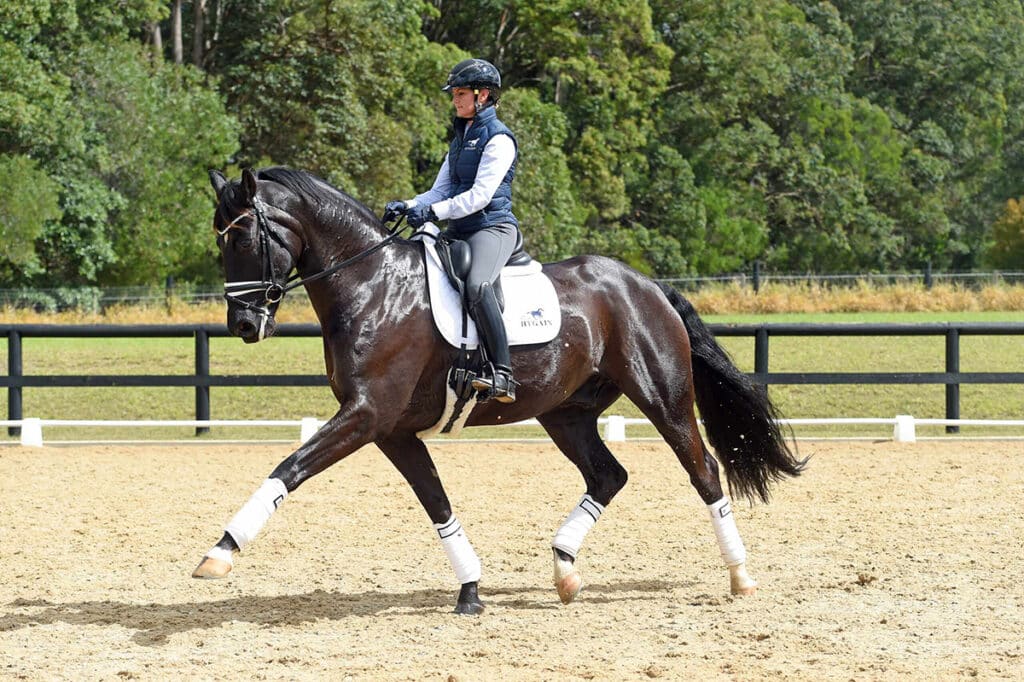
Emma and Scarlatti training. Image by Oz Shotz.
REBUILDING FROM THE GROUND UP
For half a year, Emma waited. Rehabilitation is a long, careful process – and those months created the foundation of a bond that would prove crucial. When she finally swung into the saddle, she realised just how green the road ahead would be.
“He was very weak and lacked a lot of confidence,” she recalls. “And that’s still his biggest weakness to this day. He’s a gentle giant – big to look at, but sensitive on the inside.”
Some horses stride into work with natural self-assurance; others need time to understand what’s being asked of them and to believe they can do it. Scarlatti fell firmly into the latter category. Emma knew that rushing him would only undermine the softness and generosity that made him special.
“I took him really slowly. I needed to build strength in his body but also reassure him mentally,” she says. “He’s enormous beside you, but he doesn’t feel big at all to ride. He has the softest contact, such willingness. He’s easy to put together. You just have to convince him that he can do it.”
Patience, consistency, and empathy became the cornerstones of his training. And Emma – well known for her quiet, thoughtful riding – proved the perfect match for a horse who needed time more than pressure.
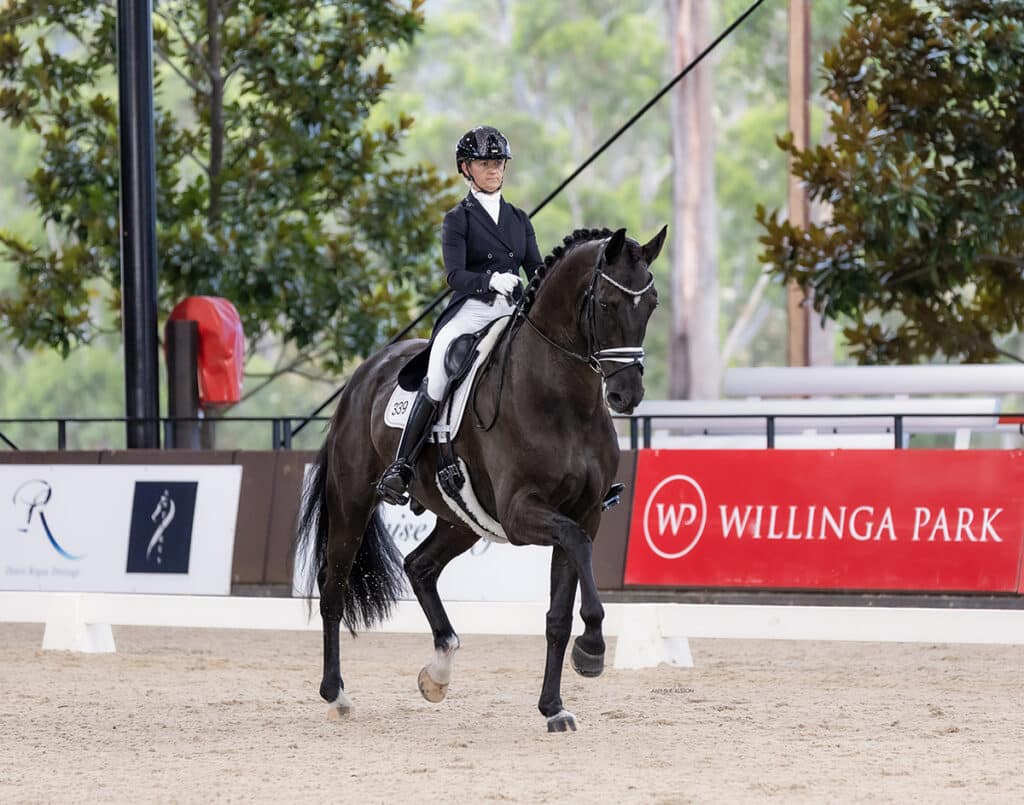
Emma and Scarlatti competing in the CDI1* Small Tour at Willinga Park Dressage by the Sea, 2024. Image by Amy Sue Alston.
A LATE START, A STEEP CLIMB
Scarlatti didn’t enter the competition arena until he was eight, a relatively late age for a horse preparing to climb toward the Grand Prix ranks. “That’s been one of our challenges,” Emma reflects. “He just didn’t get the mileage that a horse like him really needs.”
Based in Queensland – where fibre surface for competition is less common – the opportunities for high-quality show miles are limited. “We have great people here, and the sport is growing, but the number of good venues is still small,” she says. “So, gaining experience takes more travel, more planning, more financial pressure.”
Yet despite the obstacles, Emma believed in Scarlatti. Slowly, steadily, he moved through the levels with each season revealing more of the harmony and lightness that made Emma take the chance in the first place.
“I think he has the potential to be quite special,” she says. “He has this softness and lightness in his movements that really allows the harmony to shine.”
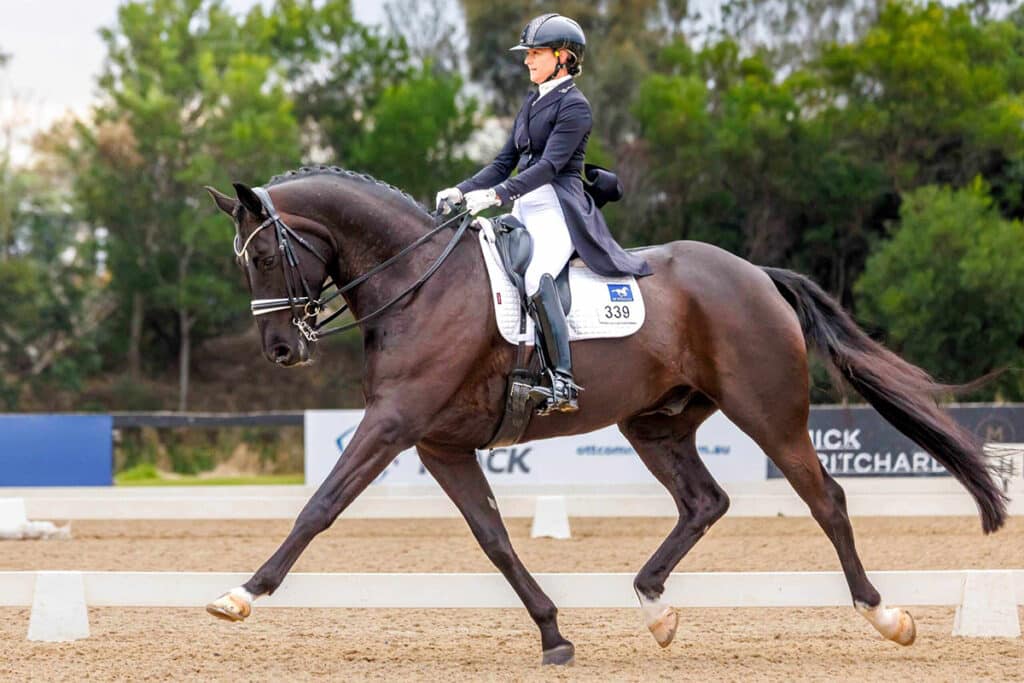
Emma and Scarlatti winning their Grand Prix CDI debut. Image by One Eyed Frog Photography.
TRIPLE WIN FOR CDI DEBUT
That time Emma took developing Scarlatti shone in the combinations first CDI Grand Prix at Boneo Park in June last year. The combination produced a test that was elastic and flowing to score 69.674% and the win – in what was Scarlatti’s second ever Grand Prix test, making it a huge feat! They backed it up with 69.808% in the Grand Prix Special and then claimed the hattrick, winning the CDI3* Grand Prix Freestyle with 73.590%.
“Boneo was an absolute dream come true! It wasn’t originally on the plan to ride at Boneo this time round as it’s such a long trip for us but after not being able to compete at Sydney CDI due to a minor travelling incident we decided to go. I’m so glad we did! We produced three good tests, although still green I was absolutely chuffed with him because the weather was less than ideal [cold, wet and windy] and he hadn’t competed in those conditions before! It was also the first time riding the Special, so I was over the moon!”
UNDERSTANDING HORSES AS INDIVIDUALS
This is not Emma’s first Grand Prix horse; he is the fourth she has competed at CDI Grand Prix, having trained Northern Meara, Andiamo and Cabaret C all from young horses through to the top level.
Emma is quick to dismiss generalisations about mares versus geldings. In her view, talent and temperament transcend gender. “Each horse presents different strengths and weaknesses,” she says. “It’s the rider’s job to understand the horse and work it out. In the end, it’s about the character – that’s what makes the difference.”
The philosophy is evident in her training. She meets each horse where they are, building systems around the individual rather than forcing them into a predetermined mould. It’s why Scarlatti flourished, even though his path looked nothing like that of her other Grand Prix horses.
“Each journey has been completely different,” Emma says. “And Scarlatti’s is still unfolding.”
WHY THE SNAFFLE MATTERS
One of the most defining elements of Scarlatti’s training and competition plan is Emma’s decision to keep him predominantly in a snaffle, even winning the 2024 Australian Dressage Championships at Medium Tour in one.
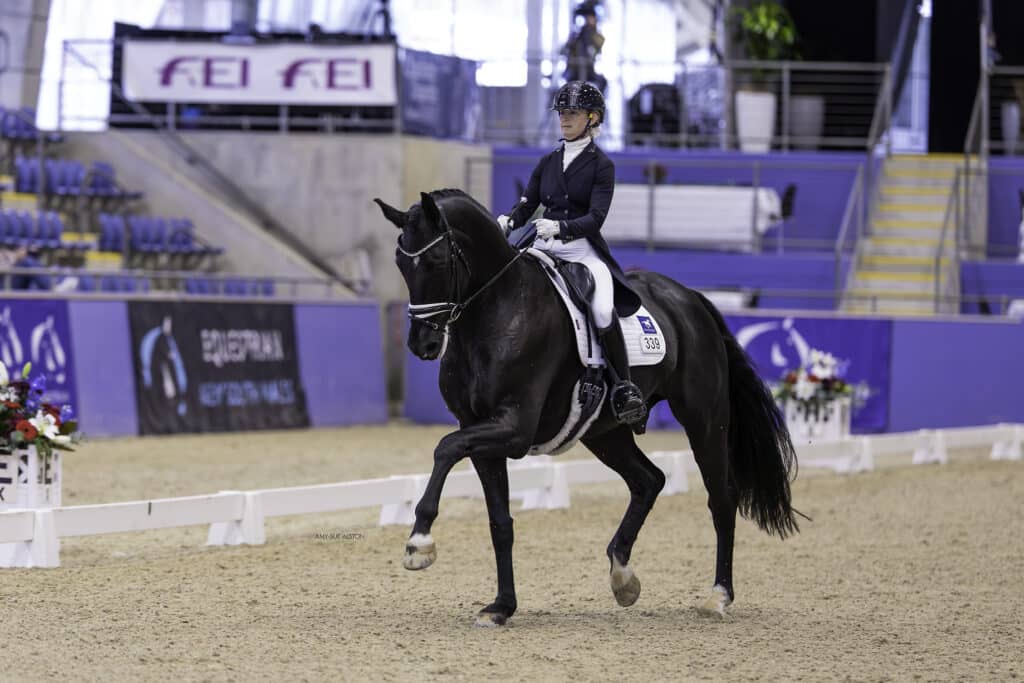
Emma and Scarlatti competing at SIEC. Image by Amy Sue Alston.
“People ask me about that a lot,” she admits. “But for him, the snaffle is where he feels secure. He’s a sensitive soul. He can go into a competition arena and just want to hide a bit.”
Whilst the combination debuted at CDI in a double per the rules at the time, the FEI announced that as of 2026 riders would have the option to compete in a snaffle in Grand Prix classes up CDI3*. This decision comes from an understanding that riders know best for their horses and allows the option for choice to achieve this.
At home, Emma trains almost exclusively in a snaffle. Maintaining that same feel in competition had kept him mentally level. “He gives such a beautiful feeling in the snaffle,” Emma explains. “So why put him in a double just for show? Grand Prix is hard enough. If he’s happiest and most confident in the snaffle, then that’s what he’ll stay in.”
It’s a reminder that training the upper levels isn’t a formula – it’s a dialogue. Every horse requires a different answer.
A DIFFICULT NATIONALS – AND A RESET
The 2024 Australian Dressage Championships were meant to be a milestone. The preparation went beautifully, Scarlatti felt ready, and then they walked into the indoor.
“It was really disappointing,” Emma says with honesty. “He felt fantastic right up until the moment we entered. But inside the arena, he just wanted to disappear a bit. I wish he had more ‘look at me’ – but for now he still likes to hide.”
For a rider whose sights had been set as high as the 2026 FEI World Championships in Aachen and who had already achieved MERs in the Grand Prix and Special at their debut, the setback stung. “Before Nationals I was full of confidence. I really thought Aachen was a possibility. But horses are very humbling. They teach you that it takes the time it takes.”
Afterwards, she gave him a break – a time for him to relax and reset. “He had an easy time following the Australian Championships. I wanted to give him the time he needed. When he started watching the arena again and looking for me, I knew it was time to start back.”
Now, a new plan is forming.
Next season will be about exposure, about confidence, about miles. “We’ll get to as many competitions as possible,” she says. “Maybe even some jumping! We may have to travel a lot, which is tough living in Queensland, but it’s what he needs.”
Aachen may return to the horizon someday, but Emma’s focus has shifted to something with a little more time.
“For now, maybe the 2028 LA Olympics is a more realistic goal,” she smiles. “Onwards and upwards.”
THE FUTURE: TRAINING, TEACHING AND THE NEXT-GENERATION HORSES
Alongside Scarlatti, Emma has a promising five-year-old and another horse expected to reach Small Tour in 2026. Each represents a future beyond the immediate pressure of elite competition.
She also trains with Robert Schmerglatt, whose guidance has shaped much of her career. “Robert is an incredible mentor,” she says. “He has been with me through so many horses and stages.”
And with the sale of Mountain View – her long-running business cornerstone – Emma is ready for a shift in balance.
“With the sale of Mountain View, I plan on focusing more on my own horses and my current lesson clients,” she says. “It will be a nice feeling to have the time to put into the horses and concentrate on their development.”
After years of juggling the demands of running a major training property, coaching extensively, and competing nationally, this new chapter offers something invaluable – time.
THE QUIET POWER OF PATIENCE
Perhaps the defining thread in Emma Flavelle-Watt’s career is patience. Patience to wait through rehab. Patience to guide a sensitive horse. Patience to rebuild after disappointment. Patience to believe in potential that others might overlook.
With Scarlatti, that patience may be what brings out something extraordinary.
“I think he can be quite special,” she says. “He just needs time, and I’m willing to give it.” EQ
Related articles
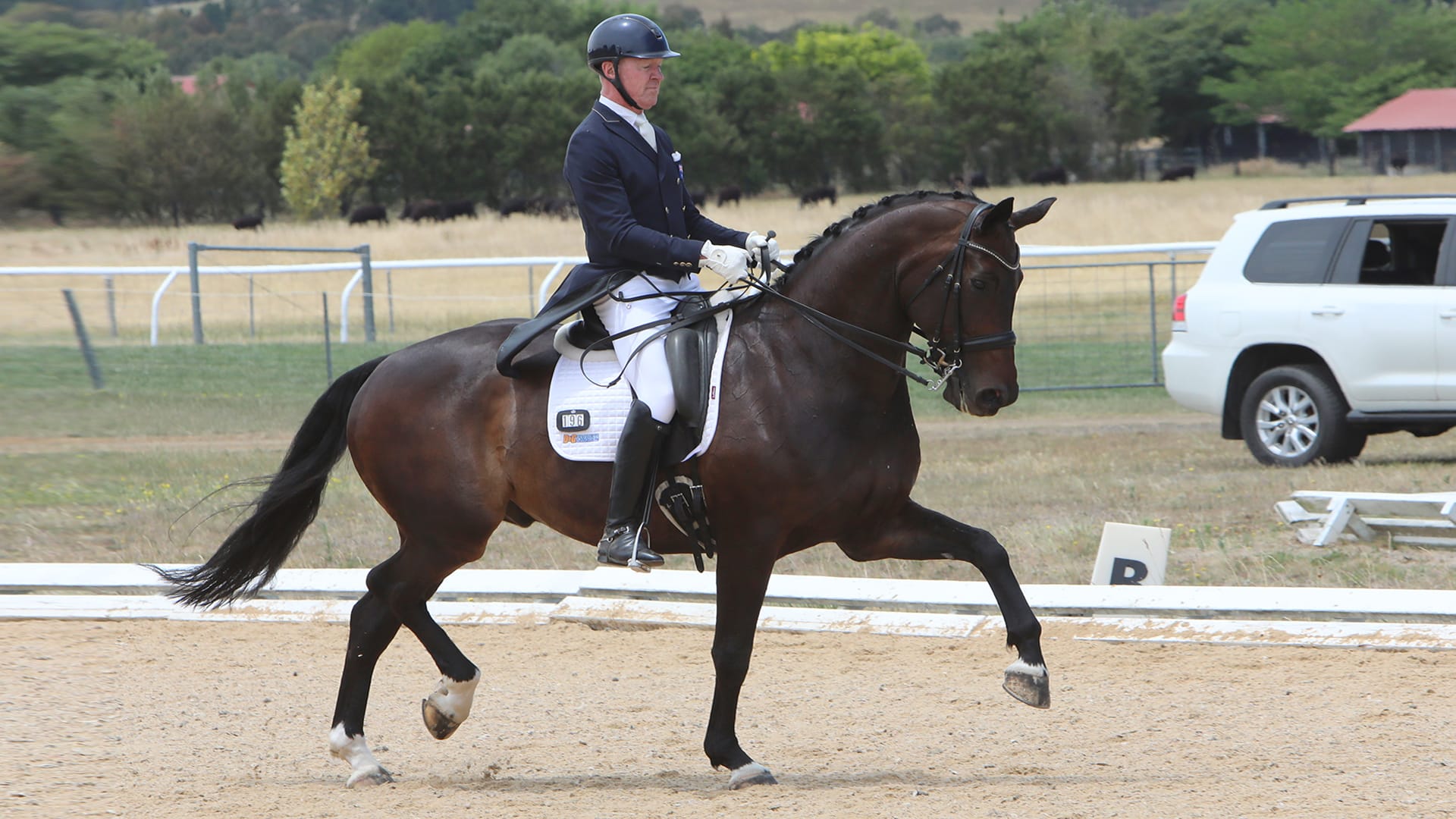
Bowral Dressage Club’s December competition showcased venue upgrades alongside strong performances and rising talent, highlighted by Matthew Dowsley and TS Firestorm’s impressive Grand Prix debut.
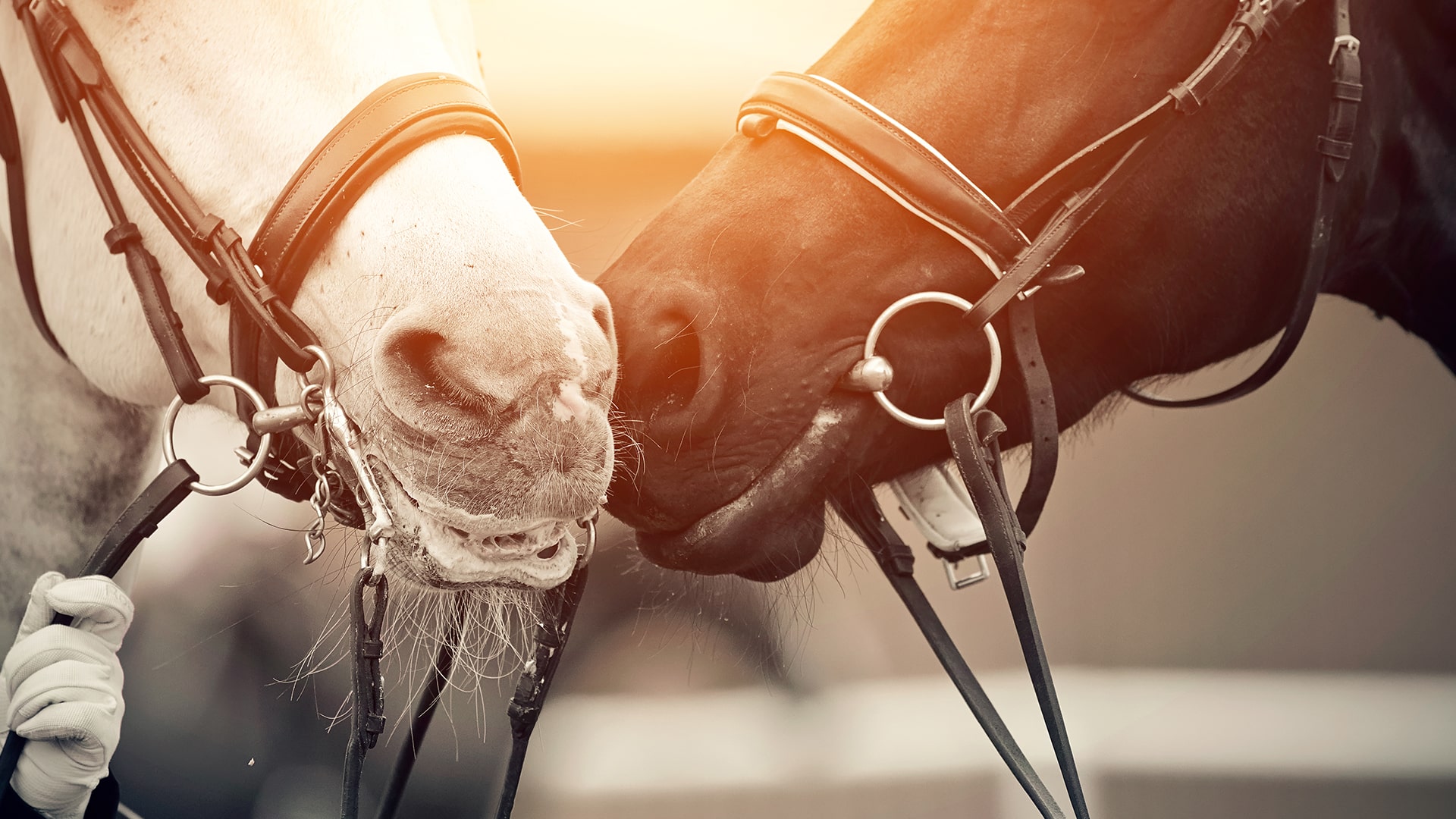
For generations the double bridle has reigned supreme in dressage. Its delicate balance of curb and bridoon bits was seen as the mark of an educated horse and a refined rider – the final step in the classical training ladder. But times are changing, and so too is the tack.