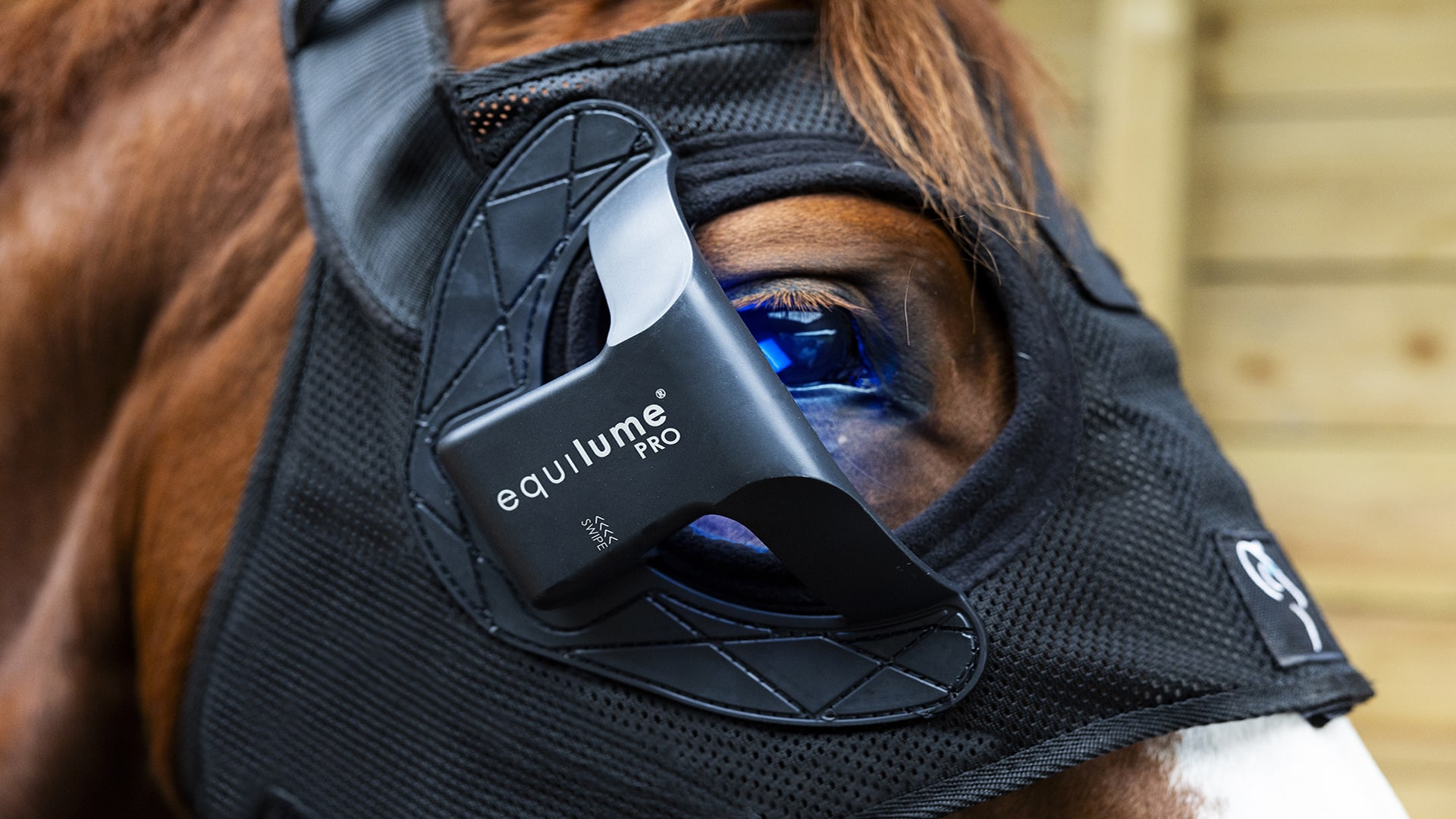
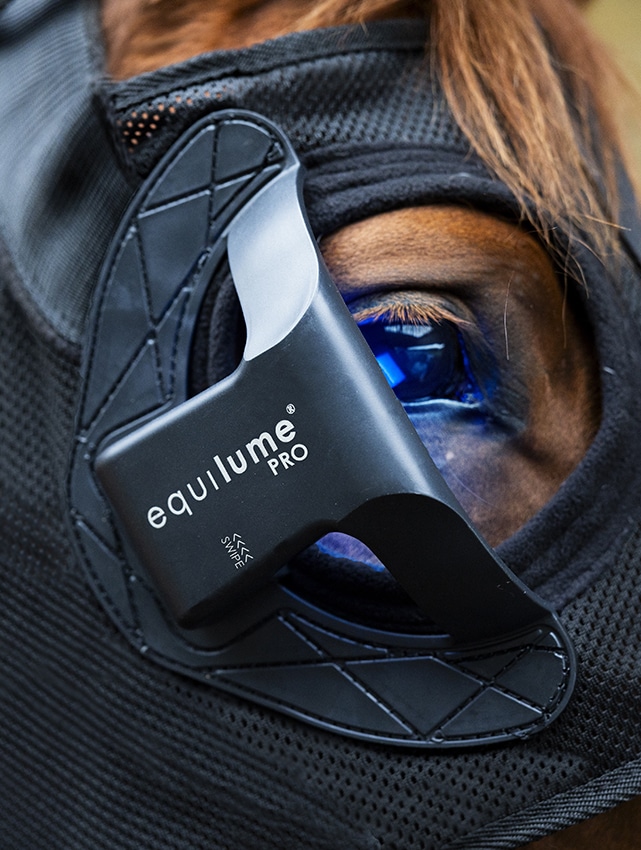


If you’re a horse owner, you already know how much your horse’s comfort and health depend on the seasons. Changes in daylight can affect everything from hair coat shedding to energy levels and appetite. For some horses, especially those dealing with PPID (Pituitary Pars Intermedia Dysfunction, also known as Cushing’s disease) or seasonal Headshaking Syndrome, these seasonal shifts can make symptoms worse.
That’s where the Equilume blue light technology (in wearable face masks or stable lights) comes in. Backed by published research evidence and user testimonials, Equilume blue light therapy is proving to be an innovative, non-invasive tool to help horses shed earlier, feel better, and reduce symptoms linked to seasonal triggers — all by simply wearing a comfortable, blue-light delivering mask or by stabling under an Equilume stable light.
Here, we break down two major research projects investigating the effects of blue light from horses diagnosed with PPID and Headshaking Syndrome and explains what they mean for everyday horse owners.
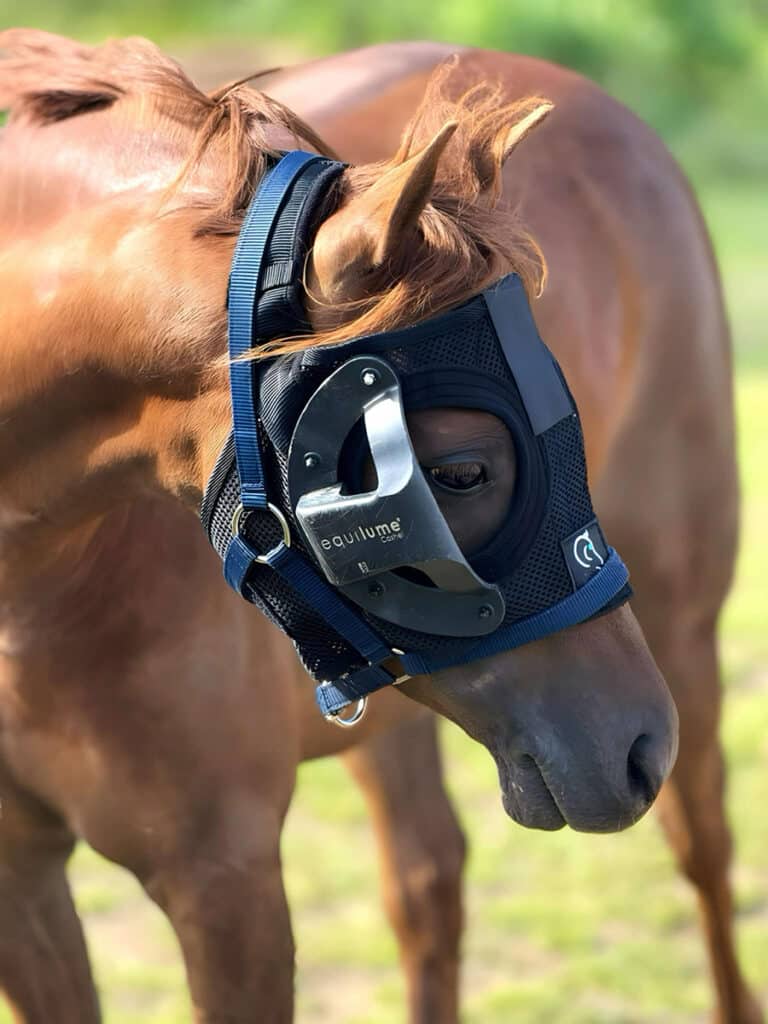
Equilume blue light technology (in wearable face masks or stable lights) is proving to be an innovative, non-invasive tool to help horses shed earlier, feel better, and reduce symptoms linked to seasonal triggers.
THE PROBLEM: SEASONAL LIGHT CHANGES MAKE SYMPTOMS WORSE
Horses are extremely sensitive to daylight. Their bodies use light to control hormones that regulate:
- Coat growth and shedding
- Energy levels
- Metabolism and fat storage
- Seasonal behaviours
In healthy horses, this natural pattern works beautifully. But in horses with PPID or seasonal headshaking, these light-driven changes can amplify symptoms.
PPID horses: Struggling with coat, energy, and fat distribution
Horses with PPID often have:
- Long, curly, or non-shedding coats (hypertrichosis)
- Erratic shedding
- Abnormal fat deposits
- Lower energy
- Recurrent infections
- Depression and lethargy
- More visible clinical signs during seasonal transitions
Short winter days can make these symptoms worse, leaving owners frustrated and horses uncomfortable.
Seasonal Headshakers: Triggered by spring and summer daylengths
A large proportion of seasonal headshaking cases are believed to be linked to changes in daylength duration which in turn increases nerve firing from the brain to activate seasonal hormones. This may also trigger the sensitive trigeminal facial nerves.
Common symptoms include:
- Repetitive head tossing
- Vertical ticcing of the head
- Nose rubbing
- Sneezing/snorting
- Eye sensitivity
- Irritability during exercise
Most owners report that symptoms come and go with the seasons, getting worse when daylength changes quickly.
THE SCIENCE: HOW BLUE LIGHT HELPS HORSES
Horses respond strongly to blue wavelengths of light, especially in the 468–480 nm range — the same spectrum used in the Equilume mask and stable light.
Blue light exposure for 15-17 hours replicates a natural “long day” signal, similar to summer daylight. This signal helps regulate the horse’s internal clock, which influences coat growth, and hormone activity.
Key scientific benefits of blue light exposure:
- Regulates hormones such as melatonin
- Encourages normal shedding
- Supports metabolism and fat distribution
- Stabilises seasonal triggers that can worsen PPID or Headshaking Syndrome symptoms
This research-driven approach is simple: maintain a consistent “summer-like” daylength by providing 15 hours of blue light daily through the Equilume Pro mask.
STUDY 1: BLUE LIGHT MASK BENEFITS FOR HORSES WITH PPID
A large 13-month study tracked horses diagnosed with PPID. Some wore Equilume Pro masks beginning December 1st, delivering 15 hours of blue light every day from 8 am to 11 pm. The control horses stayed under natural light only. All horses were also medicated with pergolide mesylate, so improvements were complementary to medication effects.
What researchers measured
Owners collected monthly data on:
- Hair samples
- Body condition scores (1–9)
- Shedding scores (1–4)
- Changes in clinical signs
- Overall quality of life
More than 7,360 individual hairs were measured — an impressive dataset.
The results: What changed in mask-wearing horses
Even though overall hair length didn’t change, the horses wearing Equilume masks:
- Shed earlier in spring
- Kept shedding later into autumn
- Showed improvements in coat condition
- Had fewer abnormal coat-growth patterns
- Showed reduced abnormal fat deposits
- Appeared to have higher energy levels after just two months
Most importantly, owners consistently reported improvements in quality of life and reductions in PPID clinical signs compared to control horses.
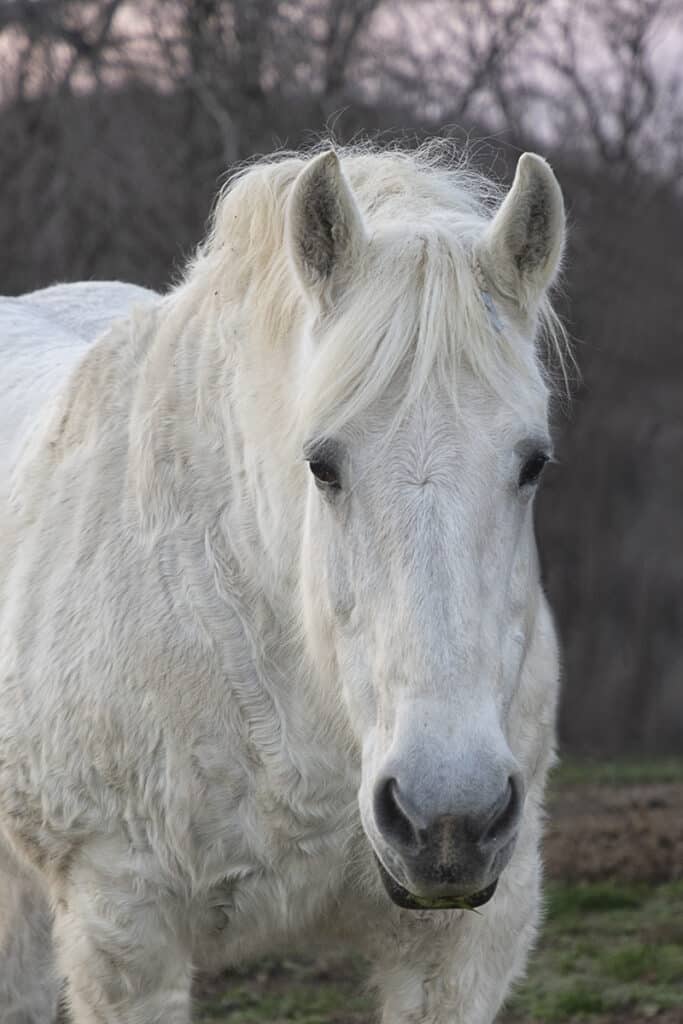
For some horses, especially those dealing with PPID (Pituitary Pars Intermedia Dysfunction, also known as Cushing’s disease) or seasonal shifts can make symptoms worse.
WHAT THIS MEANS FOR HORSE OWNERS
For horses struggling with heavy coats, poor shedding, or seasonal energy dips, providing consistent light through winter can make their bodies function more normally. It’s not a replacement for vet care or medication, but a powerful complementary treatment.
Dr. Andrea Waymouth DVM says: “My 23-year-old mare Lyka was suffering from PPID (Cushings disease). Her worst time of year was usually between April and September, when we usually could not ride her as she was so depressed, generally sore, had poor body condition, was losing her topline and had no energy.
“With the Equilume light mask on it was the first Autumn/Winter she was rideable in three years and we could not be happier with the results. Using the Equilume mask was the only alteration we had made to her management and lifestyle. We first put it on her in January and despite being 23 years old, she was then so full of life and absolutely loved jumping. I put that down to the benefit of having the Equilume blue light therapy and would recommend the light masks for other horses with a similar condition.
“While her blood results had not changed, the change in her behaviour and body condition means her quality of life with PPID was much improved. Thank you Equilume.”
STUDY 2: BLUE LIGHT MASK EFFECTS ON SEASONAL HEADSHAKING
A second study examined how blue light might help horses with seasonal Headshaking Syndrome. These horses often flare up when daylength changes rapidly — especially around the spring equinox.
How the study worked:
- Horses (n=17) acted as their own controls
- Equilume masks were fitted at the autumn equinox
- The masks provided 15 hours of blue light daily
- Owners tracked six common clinical signs and scored the intensity on a 0-4 scale
- Data was collected before, during, and after the study
Results: Real reductions in headshaking
Among participants with complete data (n=10):
- Seven out of ten showed improvement
- Two horses had complete elimination of symptoms
- Overall clinical sign intensity decreased over time
- Owners reported improved quality of life
- Symptoms tended to stabilise after maintaining long-day light through winter
While the results were not statistically significant for each individual symptom, five out of six clinical signs showed numerical improvement, and the overall trend was clearly positive.
WHAT THIS MEANS FOR HORSE OWNERS
Maintaining a “summer light” signal helps reduce the seasonal triggers believed to aggravate facial nerve sensitivity. Many horses become more comfortable, and some may even show full resolution during the treatment period.
Best practice recommendations from researchers:
- Start mid-summer
- Maintain long-day lighting through winter
- Results may vary, but success stories are common
‘My horse no longer suffers from Headshaking thanks to Equilume…’
“My beautiful gelding Tux had been headshaking for almost six years. He would exhibit severe anxiety, vertical ticcing and nose-rubbing behaviour seasonally from May through to October here in Brisbane, Australia,” says Olivia McDermott, owner of Tux.
“An oestrus control vaccine was the only treatment that seemed to help with symptoms, but when this was discontinued, he reverted to very distressing headshaking behaviour, to the point that I almost made the heartbreaking decision to have him put to sleep. I had become frightened of his unpredictable behaviour and could see how much distress he was in.
“After hearing about Dr. Murphy’s research with blue light masks for headshaking, I reached out to see if this might help as a last resort.
“We fitted the Equilume Pro Light Mask on Tux and it has been an absolute gamechanger! This mask has completely resolved his headshaking, and he is back to being a happy, healthy horse. I cannot thank Equilume enough, or express how grateful I am, that I don’t have to make that heartbreaking decision now and my beautiful boy is happy again.”
WHY THE EQUILUME MASK WORKS FOR REAL HORSE OWNERS
These studies highlight what owners are already seeing:
- Horses shed earlier and more normally
- Coats look healthier
- Fat pads improve
- Energy increases
- Seasonal headshaking decreases or disappears
- Horses seem more comfortable and happy
And because the Equilume mask is automated and wearable, horses receive consistent, targeted blue light without the need for barn lighting or schedule changes.
IS THE EQUILUME LIGHT MASK OR STABLE LIGHT RIGHT FOR YOUR HORSE?
Consider the Equilume light mask if your horse:
Has PPID and struggles with long hair or delayed shedding
Shows seasonal headshaking symptoms
Experiences dips in energy or mood in winter
Has coat or fat distribution changes linked to seasonal light
Lives outdoors or in variable lighting conditions
Could benefit from a simple, non-invasive, research-backed tool
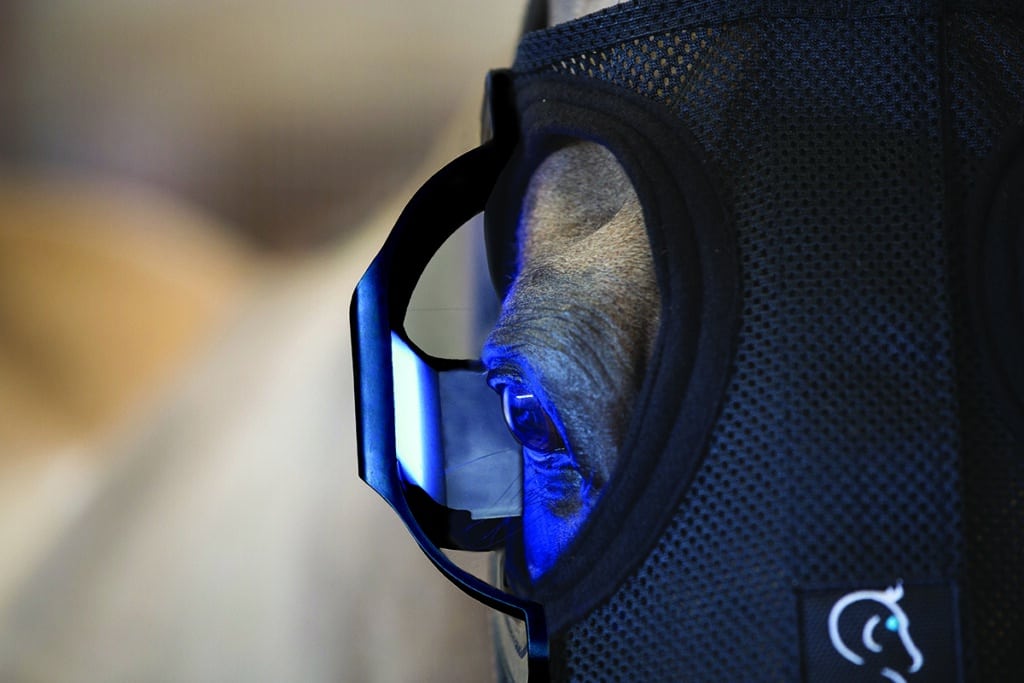
Equilume’s blue light mask works with your horse’s natural biology, delivering a carefully controlled long-day signal that helps stabilise hormones, coat growth, and seasonal triggers.
BENEFITS AT A GLANCE
- Supports healthy shedding patterns
- May reduce clinical signs of PPID
- Helps manage seasonal headshaking
- Improves perceived quality of life
- Regulates natural equine hormone cycles
- Safe, comfortable, and easy to use
For more information, visit www.equilume.com/aus/research.
Your horse’s body responds to daylength changes. When those changes are too pronounced for some horses — especially those diagnosed with PPID or seasonal headshaking syndrome — symptoms can worsen. Equilume’s blue light mask works with your horse’s natural biology, delivering a carefully controlled long-day signal that helps stabilise hormones, coat growth, and seasonal triggers.
The research is clear: Light matters. And with the Equilume mask, you can use it to your horse’s advantage. If you’re looking for a science-backed way to support your horse’s comfort and health year-round, this innovative equine light therapy may be the solution for your horse.
This article was written in conjunction with Equilume. To find out more about their product range, click here. EQ
Related articles
For successful breeding outcomes, timing is everything. Equilume’s award-winning mobile Light Masks and smart Stable Lights ensure maximum success for timely conceptions.
Environmental light is the most important cue influencing a horse’s mental and physical wellbeing. Mimicking nature’s light is a key consideration for equine health and performance.