

Plan or pay the price
The most important thing about living with the prospect of fire is to really plan ahead. If you haven’t got access to an indoor arena, and it looks like there’s potentially a fire, then you should plan ahead to move your horses well before any threat. People need to also be very sensible about it. If it’s too late then you just have to leave your horses to it. You don’t want to make your love for animals go so far you end up losing your own life, which has happened before and will happen again. Where a lot of mistakes happen is when people become much more concerned about their horse and they end up getting burnt themselves. If you have horses, you have to plan ahead — even if you decide to take them out and the fire doesn’t end up coming near you. People tend to leave it all to late…
Leave paddock gates open, take the rugs off, fly veils… anything with synthetic material will melt and burn and cause more severe injuries than the fire itself. A leather head collar would be okay, because that will enable someone to catch the horse when the fire has passed. That’s the bare minimum I would leave on. Horses can sometimes outpace a slow moving fire. Sheep, on the other hand, tend to just stay still, they have a different instinct and unlike horses they are not as evolved for grasslands, more for mountainous regions.
If a horse is running about, you can waste valuable time trying to catch it rather than getting out yourself. If you have a warning of high temperatures and strong winds, then you should start Plan A, getting the horse float ready. Then, if there is any hint of a fire you can get them out if it is safe to do so. People had some success putting horses in road tunnels and underpasses or holding yards, such as during the Canberra fires. Horses are drawn to each other, so keeping them together in familiar groups and with paddock mates makes a huge difference. You need to be aware of likely directions where the fire will come from and your escape routes are. However, where we live, if a fire comes from the north we wouldn’t consider escaping south through the forest as that would be too risky. It is a big mistake to try and drive through difficult roads.
After a fire, horses can become a bit trigger-happy with their flight response; they may be more sensitised to fearful stimuli and so it is likely that other stimuli can trigger their fear. From a veterinary point of view, you have to keep a check on hooves, as laminitis and other hoof issues can occur due to burnt hooves. Stress colic or respiratory issues are also not uncommon.
The McLean’s experience during Black Saturday fires
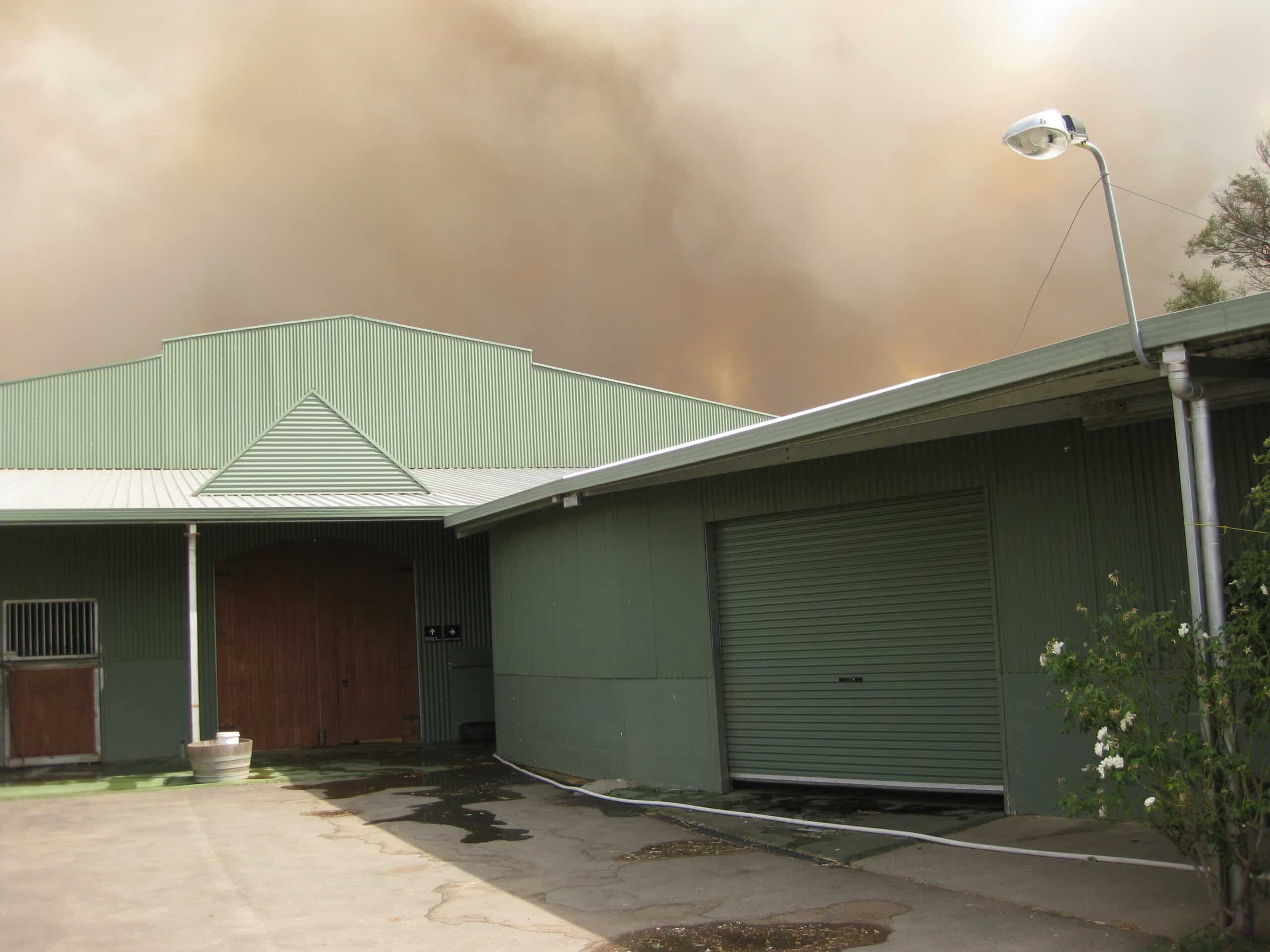
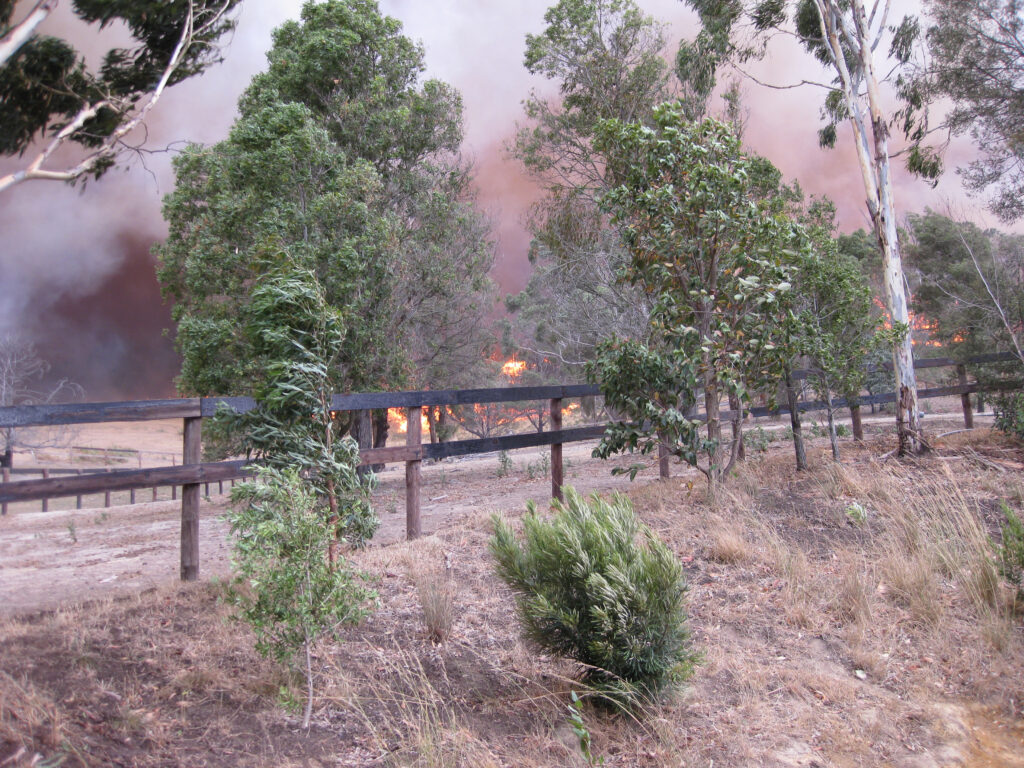
Our experience of the Black Saturday fires of 2009 was rather severe. When the Australian Equine Behaviour Centre was at Clonbinane, we were right next to Kinglake National Park and only about an hour north of Melbourne. The fire began eight kilometers to our west and the front passed through the middle of the property, about 50 metres from our house and 150 metres from our stables and indoor arena. Then it went to Kinglake and Marysville south-east of us, before turning in the afternoon when the winds changed and it came hurtling back toward us as a much bigger fire. My son Warwick and I were stuck in NSW so Manuela and the AEBC team had to deal with the majority of the fire themselves. We had a good fire plan as we had a few close shaves in earlier years. Warwick and I finally got home at the tail end of the afternoon fire despite the police refusing to let us get home and barricading our road. It was extraordinary driving through the unrecognisable road, over fallen powerlines and trees still burning.
I have done some research on horses in bushfires, however, not much research has been done overall, and it’s hard to know what is really accurate and what isn’t, because a lot of people are making out that horses are very clever in fires and that they have good instincts in such situations. This may be true to some extent but one thing they mostly seem to do is to run. Horses have sometimes survived grassfires by running head-on into it and have even been to seen to have jumped the fire wall. I think it’s more the panic, because there is smoke, noise and so much unfamiliarity and often more than just one fire front and winds, and they can become quite confused. Generally the research suggests that they are better off in familiar places, but these need to be large enough for them to move around. Horses tend to congregate in bare areas and around water troughs. Many horses have been found huddled and with their rump turned to the fire and their heads low, just like they do in wind and storm. That’s why many burn injuries on horses are on the rump area as well as the feet. However, you will still find burn marks in eyes and nostrils because horses run away if they are able.
It’s often a good idea to confine horses if the place of confinement is safe, because the less they run the better. Horses are such panicky animals, the flight response can increase to such a level that they run blind, injuring themselves and sometimes into the fire. If you cut a gap in the fence for the horses to get through, they may be less inclined to go through there because there has never been a gap there before. You are better off to leave gates open where they are familiar with the openings.
At the AEBC, all the horses were put in the indoor arena and the two stallions were in stables. There were about 35 horses on the property then. That worked really well, they were in there for about five days. One of our pupils was a rider from Finland. She happened to be an air stewardess with Finnair and her specialty was dealing with fires on aircraft. She was alarmingly comfortable about the fire and almost insisted to be at the indoor arena to look after the horses. We had spot fires landing because we had little grass here at that time of the year, and embers were dropping from the sky, so it was a matter of containing that potential. Interestingly, the horses were more concerned about their social lives with them all being together. They tried to stay in their own little groups of paddock neighbours and keep others out who they didn’t consider their friends. Chestnuts seem to band together too. It taught me a lot about group housing.
In the indoor arena the horses were eating from multiple feed buckets and could retreat when they felt attacked. After almost one week in the indoor arena we had just one bite mark on the neck and that was all. Our indoor arena is 70 by 30 metres, so it is fairly large, but nonetheless, in all that time there were no other significant injuries.
Useful contacts
The emergency websites for each state will provide you with the most up to date news. Downloading the app to your phone allows you to set up watch zones that will send you notifications if an incident occurs within them.
Additionally CFA have their own recommendations, mirroring McLean’s advice, they advise owners to remove all rugs from horses, have as much space for them to move around to avoid fire and if planning to leave, do it before the day is classified as catastrophic or extreme fire danger.
They recommend evacuating to a neighbour or friend’s property that is better prepared than yours, local showgrounds, saleyards, racetracks and pony club grounds if they are better prepared than your own property.
Many equestrian centres also open their doors in times of need.
As Victoria is currently heavily impacted by fires, Equestrian Life is thinking of all those involved and hoping everyone remains safe.